Search This Blog

Tuesday, January 10, 2012

Settlers Attack House, Burn Car East of Hebron

Date : 9/1/2012   Time : 11:01

HEBRON, January 9, 2012 (WAFA) – Dozens of Jewish settlers attacked early Monday a Palestinian house and burnt a car in al-Baqa'a area, east of Hebron in the southern West Bank, according to witnesses.
Atta Jaber, a resident in the area, told WAFA that dozens of settlers attacked the house of Jodi Abdul Jawad, throwing stones at it, and set fire to his car, completely burning it.
He added that the settlers were divided into two groups; one set Abdul Jawad’s car on fire and the other attacked the house with stones to prevent Abdul Jawad from coming out to defend his property.
Baqa’a residents are regularly subjected to attacks and harassment by settlers from Kiryat Arba and Kharsina. Their property is also threatened with seizure by the Israeli authorities, which aim through the settlers’ attacks to force the farmers and residents to leave their land.
T.R./M.S.

http://english.wafa.ps/index.php?action=detail&id=18619&utm_medium=twitter&utm_source=twitterfeed

Dr Amer: The countdown to a new Israeli war on Gaza started

[ 09/01/2012 - 12:44 PM ]


GAZA, (PIC)– Specialist in Israeli affairs and political analyst Dr. Adnan Abu Amer said the countdown to new military aggression against the Gaza Strip started, but when this war would happen is not yet decided by the Israeli occupation regime.

Dr. Amer made his remarks in a political symposium held on Sunday in Al-Omah university in Gaza.

“I think the occupation is busy now more than ever mulling over the timeline for a military campaign that seems to be closer,” the specialist in Israeli affairs stated.

He explained that the Israeli occupation, through its war threats, has sent several messages to the Arabs and the first of them is political.

“The regional changes, the occupation’s losing of more allies after the Arab spring and its military and security exposure have made it to live in a state of panic. The Israeli decision-maker wants to regain the balance he has lost and send a message that the war is not directed against Gaza and its resistance but against the political region around Gaza which changed greatly,” the specialist added.

The second message is related to the Israeli intelligence concern about the growing capabilities of the Palestinian resistance in Gaza and its thirst to explore them, the specialist elaborated.

“The enemy will not stand up for the growing development of the resistance which has turned from guerrilla groups to a regular army, so it wants to test the weapons of the resistance and the level it has reached.”
For his part, Hamas spokesman Fawzi Barhoum, who took part in the symposium, said his Movement is geared up to confront any new Israeli aggression against Gaza.

“We are prepared for the war and deal with the Israeli treats at the same time as a psychological warfare,” spokesman Barhoum stated.

The spokesman stressed that the competition between Israeli leaders are based on who can inflict the biggest losses among the Palestinians.

“An Israeli leader cannot run for elections before his track record is examined to see if he is a killer or a politician, and of course if he is a killer he will win the elections,” he added.

Source and more at the Palestinian Information Center

Twitter reveals JNF’s approach toward Palestinian Bedouin

In a tweet that was later deleted, the Jewish National Fund says Bedouins in unrecognized villages are “living on someone’s land illegally.” The JNF has been taking part in evacuations of Palestinians in East Jerusalem and in foresting actions aimed at preventing the Bedouin from accessing their lands; last month, a JNF board member resigned, citing “violation of human rights” by the organization

In recent months, we have reported here on the Jewish National Fund’s role in attempts to take over Palestinian homes in East Jerusalem and in the evacuations of Palestinian Bedouins from their homes in the Negev desert.

The Fund – originally established to buy lands in the early days of Zionism – is today a quasi-government agency that controls 13 percent of the land in Israel. Since the fund only sells lands to Jews, the government occasionally transfers real estate in disputed areas to the fund, so it can carry out discriminatory policies that the government is forbidden from exercising directly. Such are the cases in East Jerusalem.

In the south, the fund does foresting work on the lands of unrecognized Palestinian villages, aimed at preventing Bedouins from rebuilding their homes. Last week, the Abu al-Qian Bedouin clan protested plans to evacute them from their homes in the Yatir area in order to make room for another JNF forest.

Last Thursday, there was an interesting tweet from the JNF USA office, essentially admitting that the Fund sees the Bedouin citizens of Israel as illegal invaders in their own land:


After several followers re-tweeted this message, the tweet was deleted. A new tweet directed readers to a public statement by the fund, claiming that the Bedouin issue “is too complicated to debate in 140 [characters].”

“The issue” is in fact not that complicated. When Israel was established, it chose not to recognize Bedouin ownership of  lands that they cultivated or lived on, making them illegal residents in their own home – even in cases where those settlements predated the state itself. More than 60 years after, the state still tries to evacuate the Bedouin, while refusing to connect them to infrastructure such as electricity and water. Yet in the world of the Jewish National Fund, its not even a disputed territory: All lands belongs to Jews by default, and people – Israeli citizens! – living there are doing so “illegally.”

The Jewish National Fund is knowingly and willingly taking an active role in taking over the lands of indigenous population in different parts of Israel and the occupied territories. Lately, JNF board member Seth Morrison resigned from the organization, calling its evacuations of Palestinians in East Jerusalem a “violation of human rights.”

Rabbis for Human Rights have launched a campaign against the Jewish National Fund’s attempts to take over Palestinian homes and evacuate Bedouins from their lands. You can read more about it here.

Read also:

Protest against settler-friendly JNF expands, raises existential questions
Forced relocation of 30K Bedouin biggest dispossession since ’48

http://972mag.com/twitter-reveals-jnfs-approach-toward-palestinian-bedouin/32360/

IOA delivers demolition notices to seven families in Al-Khalil

[ 09/01/2012 - 07:48 PM ]


AL-KHALIL, (PIC)– The Israeli occupation authority (IOA) served demolition notices to owners of seven families in Khirbat Um Al-Kheir to the east of Yatta town in al-Khalil province.

Ratib Al-Jibour, the coordinator of popular anti wall and settlement committees in the area, said that employees with the civil administration accompanied by Israeli occupation forces delivered the notices on Sunday.

He said that 60 citizens live in those seven houses near Karma’il settlement, which was established on the village’s land.

Jibour recalled that the IOF soldiers razed three houses in the same village a month ago, charging that the IOA was trying to terrorize inhabitants of the village to leave their hometown.

Source and more at the Palestinian Information Center

Beit Shemesh women dance for change

(Video) After their city becomes symbol of exclusion of women, secular and religious female residents decide to convey their own message in flash mob to the sounds of Queen's 'Don't Stop Me Now' 
 
Liron Nagler-Cohen
 
Published: 01.10.12, 15:37 / Israel Culture
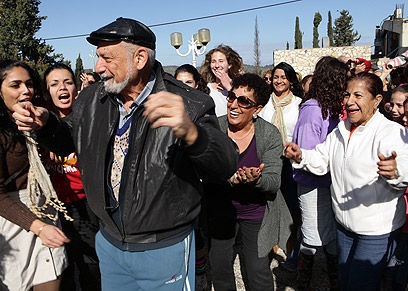
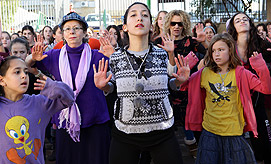
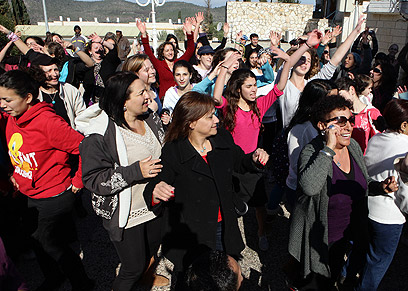
VIDEO - When guns roar on streets of Beit Shemesh – muses break into a dance: Some 200 women, most of them residents of Beit Shemesh, gathered in the city center on Friday morning to perform a flash mob to the sounds of Queen's "Don't Stop Me Now".
Moderate Perspective

Can religious women bridge IDF rifts?  / Chava Forman-Horovitz

Growing number of religious female soldiers believe it may be able to build bridges of understanding, religious tolerance within Israeli army
Full story

The song was not chosen randomly, and neither was the timing. "We had all kinds of ideas," says Miri Shalem, the project's initiator and director of the Ramat Beit Shemesh community center.

"We thought, for example, about Aretha Franklin's 'Respect' or 'I Will Survive'. It was important that the song would be in English, so that the message would be conveyed abroad too."


"I Will Survive" was eventually dropped, "because we didn't want a connotation of survival," says Shalem. The rhythmic Queen song was chosen by the choreographer, Liat Amar, and the rest is history.

A small Facebook group opened by Shalem and her friends Orna Nachmani, Etti Ben-Ami Suisa, Brenda Ganot and Paz Corcos spread the rumor, and many of the city's residents joined the initiative and even provided financial help.

'We wanted to present a different voice'

Flash mob is a way to convey a social message – and when religious and secular women dance together in the center of the city most identified with the exclusion of women, the message gets through.

The initiators – all social activists who hold management positions – set up a "women's council" several years ago, whose members are ultra-Orthodox, religious and secular women, veteran residents alongside new residents.
"הבענו בריקוד את הקול שלנו". נשים רוקדות בבית שמש (צילום: יששכר רואס)
Women dance in Beit Shemesh (Photo: Yissachar Ruas)

"In the past two weeks, Beit Shemesh has been making headlines in very negatives contexts," says Shalem, "whether on the background of separate sidewalks, a visit by the Knesset's Economic Affairs Committee on building reserves, or the story of Naama Margolese (an eight-year-old girl bullied by haredi men for being 'immodest').

"We wanted to present a different voice of many sane women who are against religious exclusion in the city, like living in Beit Shemesh and don't experience religious tensions every single moment."

תושבים הצטרפו באופן ספונטאני לחבורת הרוקדות. "אנשים מסתובבים כאן עם הראש באדמה"  (צילום: יששכר רואס)
Residents join dancing women (Photo: Yissachar Ruas)

"We were very unhappy with everything that's happened recently in terms of the exclusion of women," adds Orna Nachmani, manager of the Beit Shemesh seminary.

"It was important for us not to attack a certain public, but on the contrary – to come and say that we have a voice. We expressed our voice through the dance."

Brenda Ganot, a Jewish Agency project manager in the city, describes a situation of chronic depression. "Recently, women have been walking around here with their heads in the ground, and that's not good for one's soul. So we wanted to improve people's mood.

"I felt that it was very important to show the world that Beit Shemesh has an amazing communal organization. In the meantime, we live in a free city, where we can dance on the streets. We didn't do it in someone's face, that wasn't the goal, but there was a need to express something of a protest and positive nature at the same time. Something with good energies, which in my opinion only women can do."

Strong society

Even before the Naama Margolese affair was exposed on Channel 2 News, Beit Shemesh had already made headlines on the backdrop of the haredi struggle against a local religious school for girls.

Shalem, who at the time was considering ways to express the voice of Beth Shemesh's women, fell in love with the idea of a mass flash mob.
"אני לא יודעת אם בכל עיר אפשר היה לעשות את זה" (צילום: יששכר רואס)
'I don't know if it could be done in any city' (Photo: Yissachar Ruas)

"We worked on it for two weeks, and it turned out to be amazing," she says. "We hope this clip succeeds in explaining that Beit Shemesh is the home of a civilian society with a lot of strength. I don't know if this could be done in any city."

דתיות וחילוניות, תושבות ותיקות לצד תושבות השכונות החדשות. הפלאש-מוב (צילום: יששכר רואס)
Religious and secular, veteran and new residents (Photo: Yissachar Ruas)

Nachmani says she was surprised, "not at the number of participants, but at the variety. When we saw the response to our Facebook group, we already realized that it was serious. And with all my experience in organizing events, in most projects of this kind you don't really know who will eventually show up. But in the rehearsal the evening before, when we saw the masses, we were very happy."

The initiators – all women in their 40s, religious and secular from different parts of the city – seek to convey the message overseas as well.

"There are thousands of Anglo families living in Beit Shemesh. There are difficulties here, but there is also a different reality. Now we are moving on, thinking about other initiatives to show that we can still create a sane reality here, despite the complex reality of Sephardim and Ashkenazim, veteran and new residents, radical haredim and seculars."

Women went on dancing

Ganot and Nachmani say the goal was achieved on the ground: "Women went on dancing spontaneously even after we completed the shoot," says Ganot.

"They just didn't want to go home. This shows that something happened here. Women of different backgrounds saw that together we have the power to do positive things."
Nachmani adds, "I felt high, with so much adrenaline and a great feeling. We felt like we had done something. After all, just complaining and crying is unhelpful."

Ganot lives next to the bone of contention, the religious school for girls. "We know that these people are extremists," she says. "That's why it's important for us to show the world that Israel is not a crazy place.
"I hope we manage to protect our city. It's an amazing and beautiful place. If in the future I am no longer able to dance on the street, I won't be able to continue living here." 

http://www.ynetnews.com/articles/0,7340,L-4173737,00.html